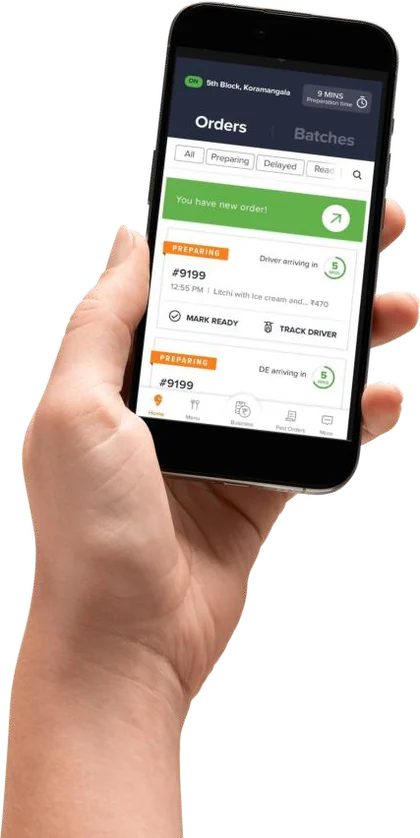
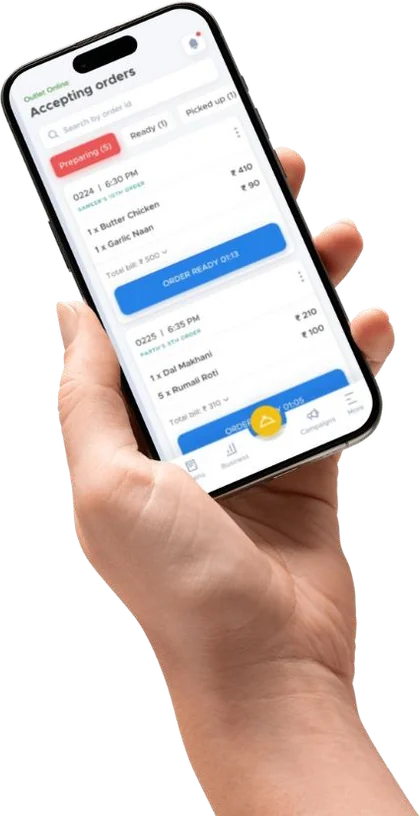
“I use Pet-Pooja to manage Swiggy and Zomato together. I hate switching apps.”
WantsOne place for every order


A story of chaos, empathy, and building a calmer world for restaurant owners.



01 / About the project
Restaurant owners on Zomato struggle with scattered orders, little visibility into performance and complex advertising. This project reimagines the Partner app as a command centre.
What is Zomato
Zomato is one of India's largest food delivery apps. Founded by Deepinder Goyal and Pankaj Chaddah, it started as Foodiebay, a restaurant listing site, and is based in Gurugram. Its parent company was renamed Eternal in 2025.
 Connects all three
Focus
The brief
Design processFive stages, three loops
Looped back from testing to research three times
Project timeline
23 days, with research, design and testing overlapping.
02 / Introduction and initial research
Running a restaurant during peak hours is organised chaos. Right at the centre stands the manager, juggling platforms and numbers that never add up.
The reality
Orders fly in, chefs shout across the kitchen, staff rush between tables, and the manager battles cluttered dashboards across multiple delivery platforms, trying to make sense of numbers that never seem to add up.
This is where Zomato Partner, a platform meant to simplify operations, often creates more confusion. When I began, I wanted to understand one simple question.
“What does a restaurant manager actually need to run operations effortlessly?”
Primary researchUnderstanding the reality on the ground
To cook up the perfect solution, I first had to understand the ingredients. I spoke to owners, managers and cashiers across different cities and business sizes. These weren't formal interviews; they were real conversations in noisy kitchens, at billing counters and during the evening rush.
What users said
From 5 staff to 26, every restaurant named the same four problems.
“I use Pet-Pooja to manage Swiggy and Zomato together. I hate switching apps.”
WantsOne place for every order
“I don't understand the analytics feature. I just do manual reports when my owner asks.”
WantsInsights without manual reports
“Apart from Instagram, we don't do any advertising. I didn't even know Zomato had ad tools.”
WantsAd tools he can find and trust
“I don't see how it will change things. Why bother learning so much?”
WantsProof that learning pays off
Customer journeyA manager's day
Four moments in the day, and how each one feels.
Zomato Swiggy
OpportunityUnified, real-time dashboard
OpportunityAI demand prediction
Zomato AdsOpportunityOne-click AI ads with ROI
OpportunityAI menu tips, gamified goals
03 / Secondary research
These weren't isolated complaints. Market reports, industry trends and food-tech data told the same story.
Sources: Grand View Research, Online Food Delivery Services Market; Toast, Restaurant Technology Trends Report 2023
Source: Economic Times, Restaurant Aggregators Under Scrutiny
Sources: HubSpot, Small Business Advertising Trends; Technomic, 2023 Foodservice Trends Report
Every year, a restaurant loses
₹5–10lakh
to slow order handling and marketing it never runs.
04 / Problem identification
Primary and secondary research, synthesised into four sharp problem statements.
Orders live across Zomato, Swiggy and a calculator.
78%of operators struggle with multiple tools
The data exists, but in a form too complex to use.
30%of owners actually use analytics
Most partners don't know Zomato has ad tools at all.
40%of campaigns fail to return their spend
Features exist, but nothing shows why they're worth learning.
“Why bother?”what managers told us
Competitive check
Zomato Partner doesn't lead in any of the five areas. Swiggy leads in four.
| Compared on five areas |
Zomato PartnerRedesign focus |
Swiggy PartnerMarket leader here |
 Uber EatsIndia, before the merger |
|---|---|---|---|
| Ease of use | FairCluttered, hard to navigate | FairSimple, little customisation | StrongStreamlined menus |
| Order management | FairNotifications arrive late | StrongReal-time, occasional lag | FairAccurate, weak coordination |
| Analytics | WeakBasic, few insights | StrongDetailed and visual | WeakMinimal, little to act on |
| Advertising | FairModerate ROI, weak targeting | StrongStrong targeting and ROI | WeakBasic, rarely used |
| Menu management | WeakSlow to update | StrongQuick edits | FairNo advanced inventory |
| Overall | 8/15 | 14/15 | 9/15 |
Ratings are my reading of each app during research: weak, fair or strong.
05 / Introducing
Zomato+. Smarter management, bigger growth. Four features for four problems.
Zomato, Swiggy, a POS and a calculator, all open at once.
06 / Solution 01
Quick order access. Shortcuts tailored to each platform, so orders can be handled from wherever the phone already is.
On Android, a floating shortcut opens the order page instantly. On iOS, actionable notifications let staff accept or reject orders straight from the notification panel. It matches real restaurant workflows, cuts cognitive load and speeds up decisions at peak hours.
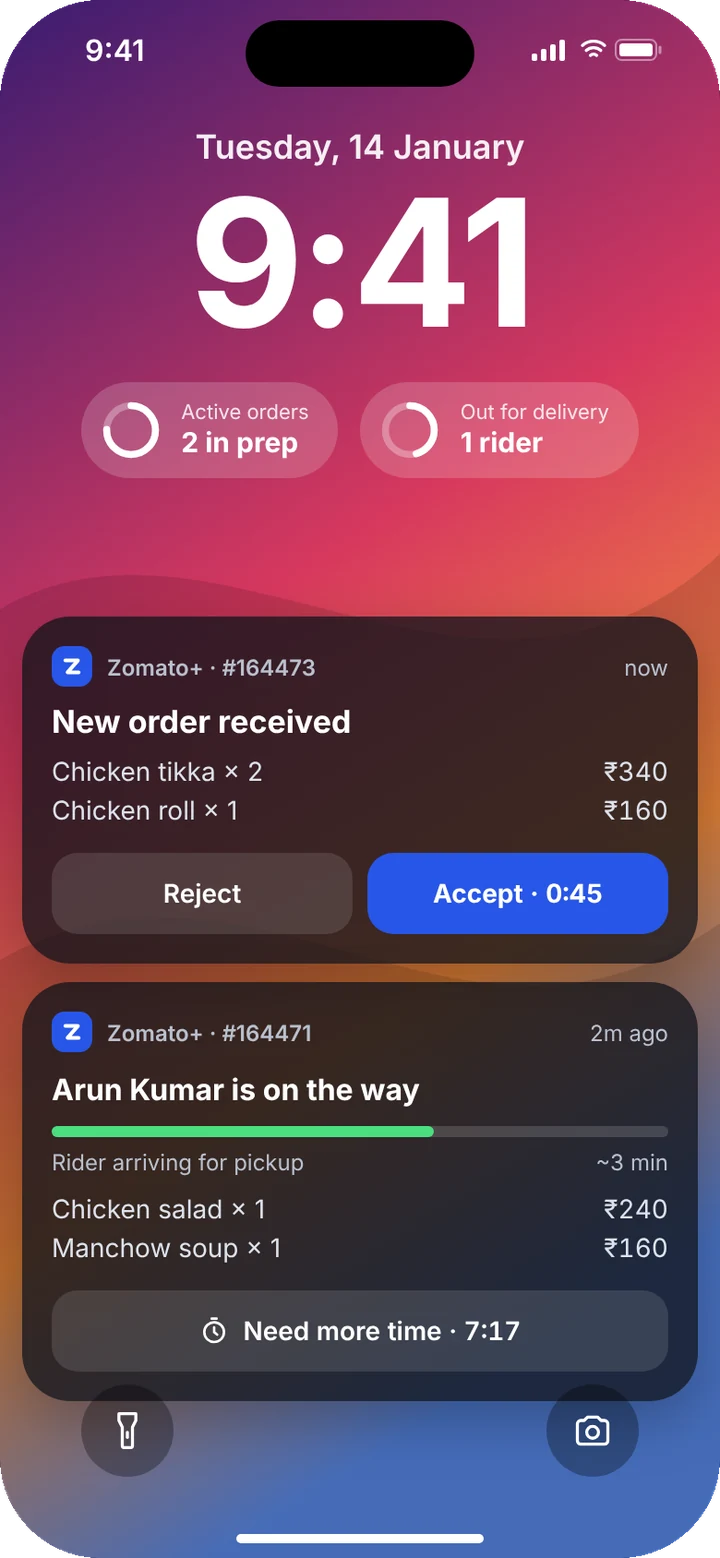
Never miss an order, even while multitasking.
Arun Kumar is on his way (3346)
ReasoningNotifications are treated as action surfaces, not just alerts. That fits real behaviour: staff are already using their phones for several tasks at once.
ImpactLess time to action and fewer dropped orders.
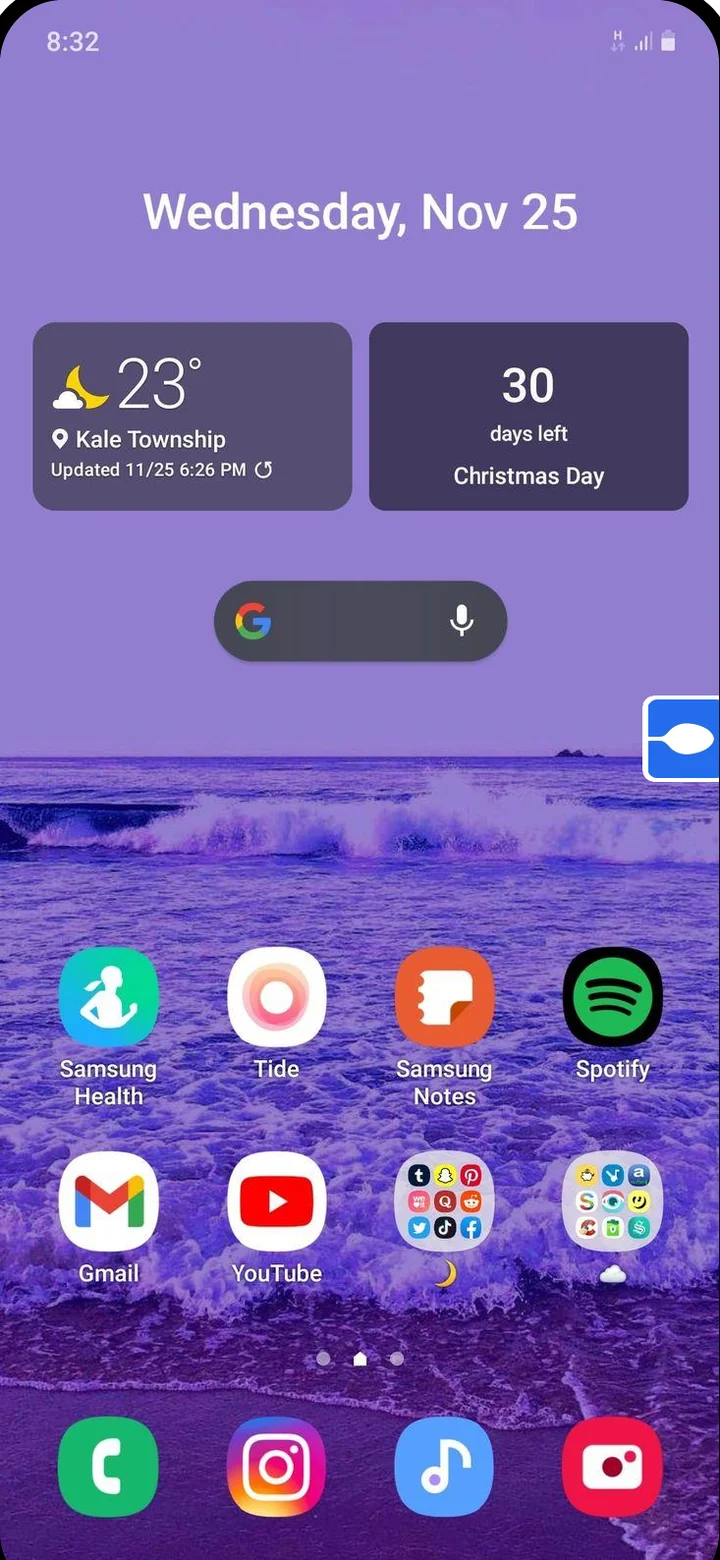
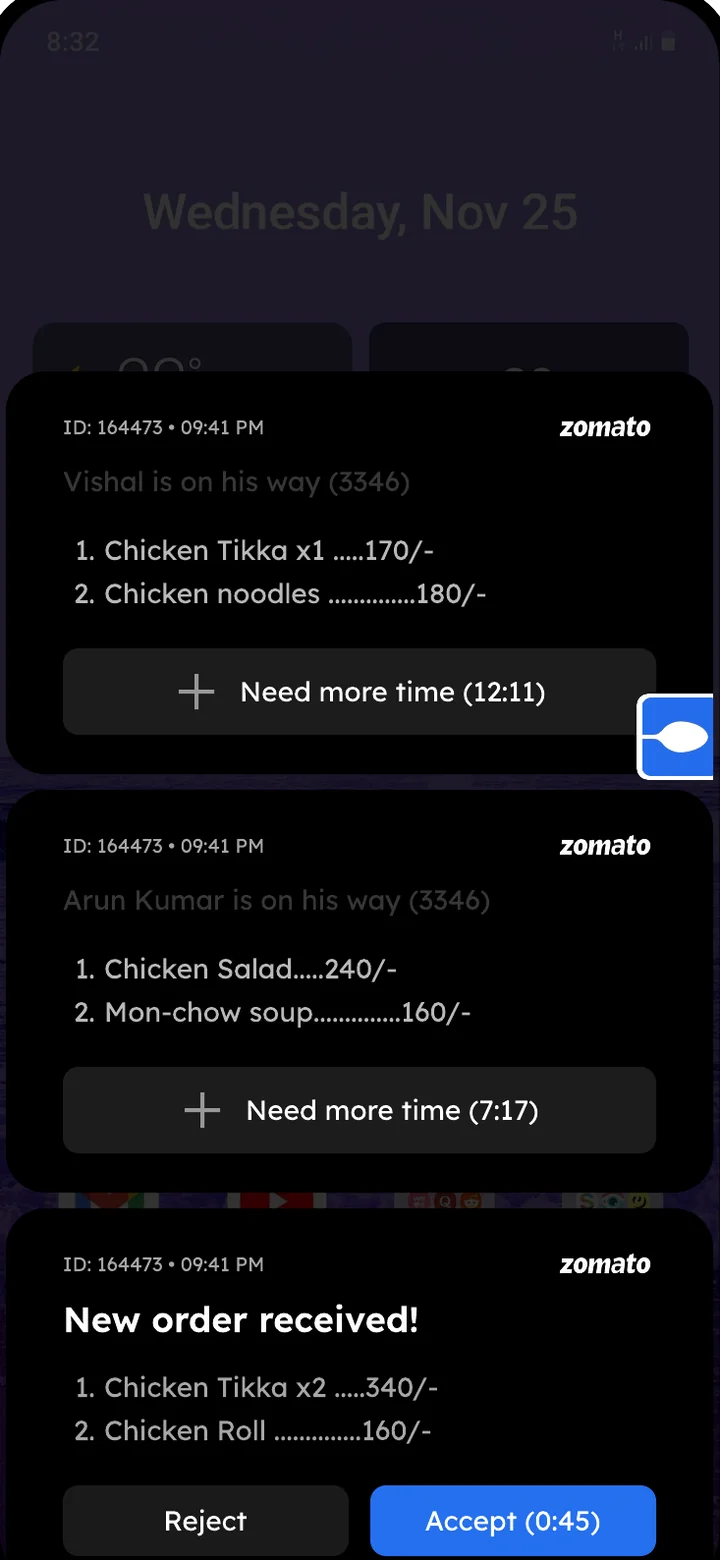
Orders, right where you are.
ReasoningBinary decisions are made easy by minimising steps and visual noise. Critical actions appear without a secondary confirmation step.
ImpactFaster responses and a better customer experience.
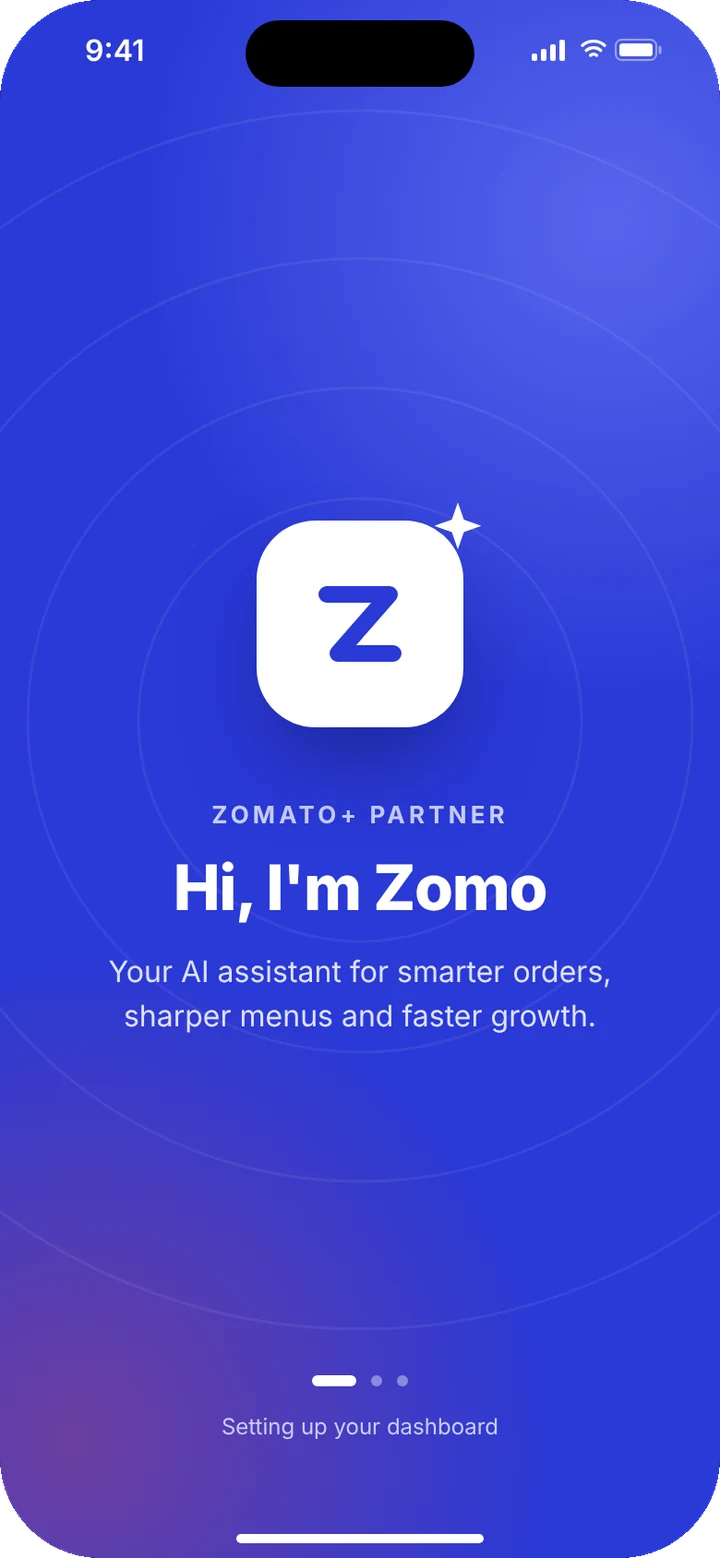
07 / Solution 02
Zomato+ introduces an AI-powered insights feature that simplifies complex data into clear, actionable recommendations. Instead of interpreting analytics by hand, partners can make informed decisions with ease.
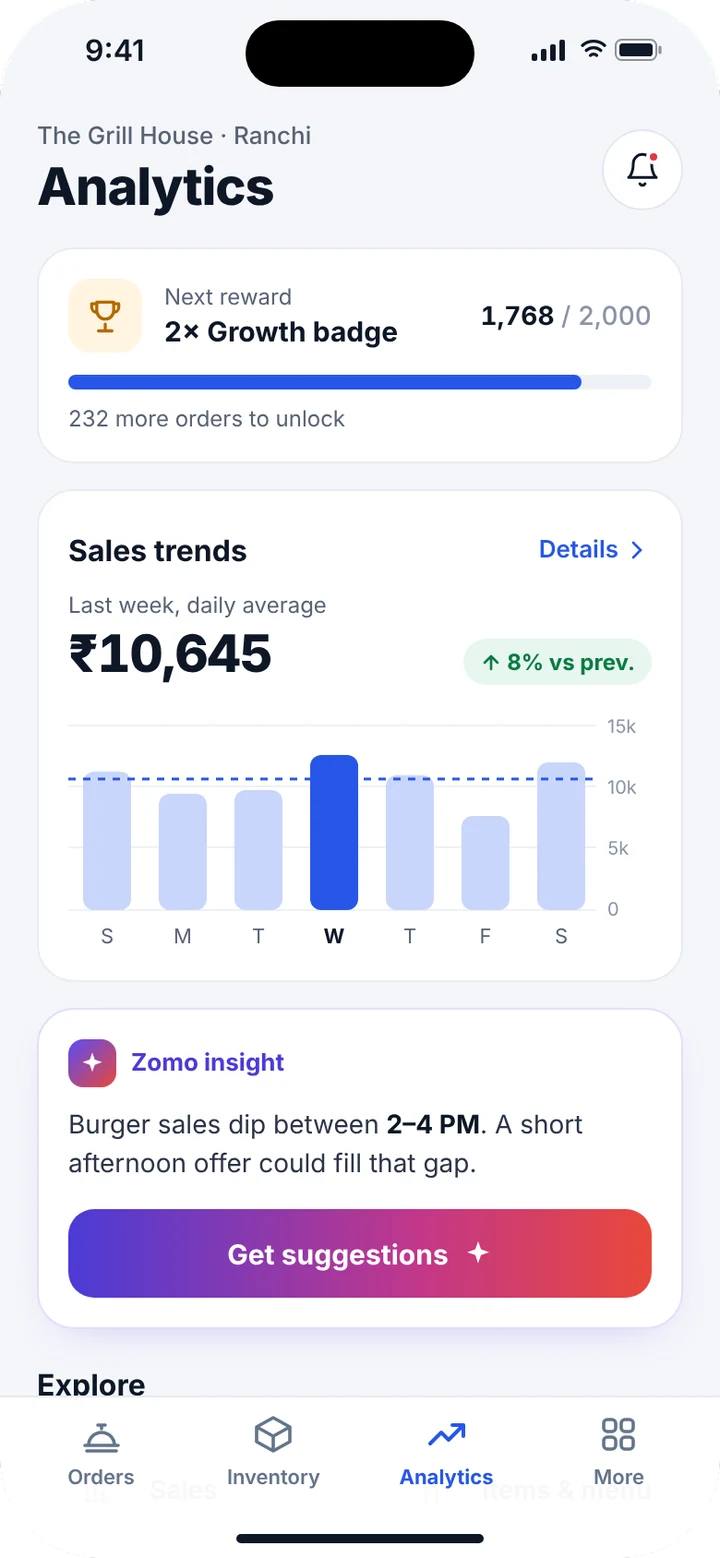
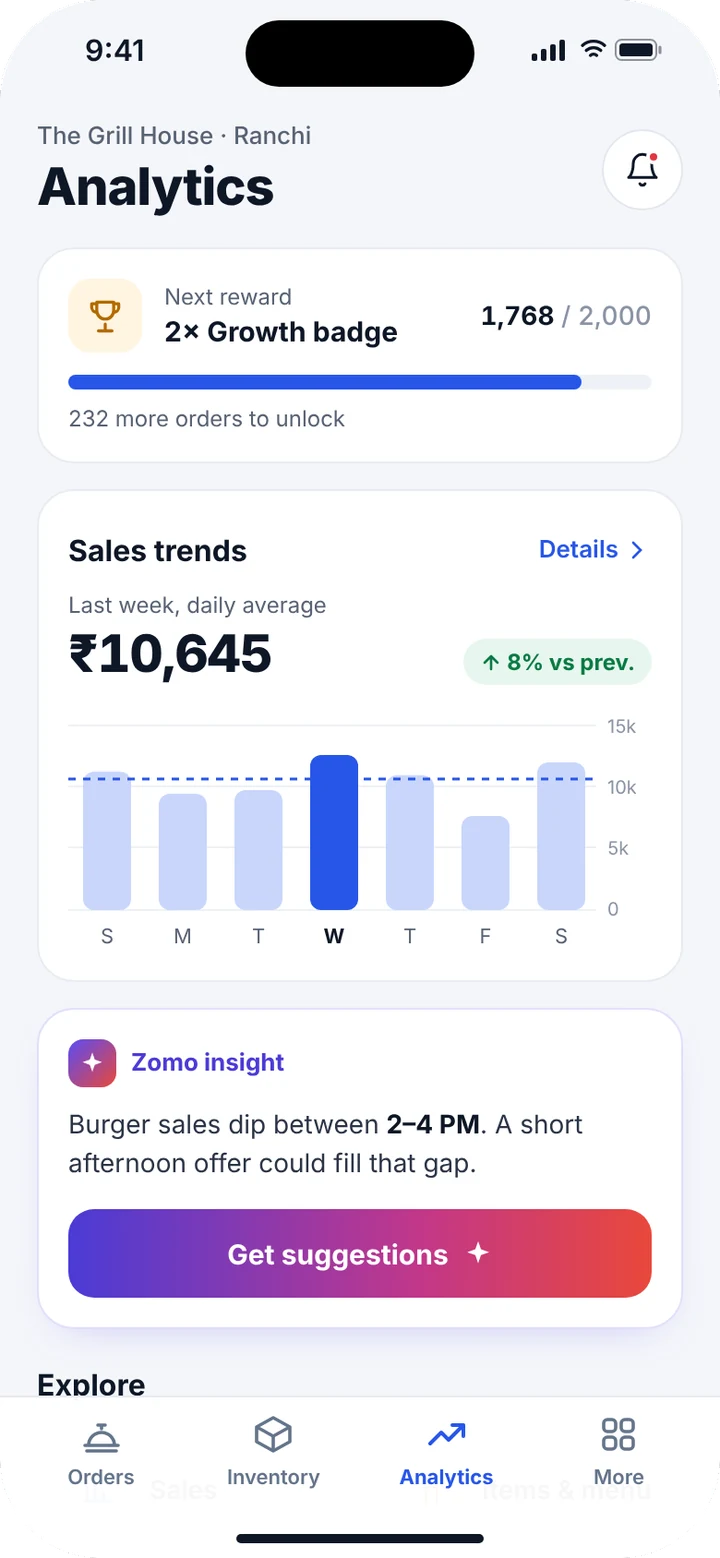
A clean, unified dashboard that surfaces the most important business metrics in seconds.
Owners can dive into sales, items and menu, ads and offers, or reviews.
ReasoningFocuses on the benefit, not the feature. Unified, clean and surfaced signals clarity, and shows the value: faster decisions and less cognitive load.
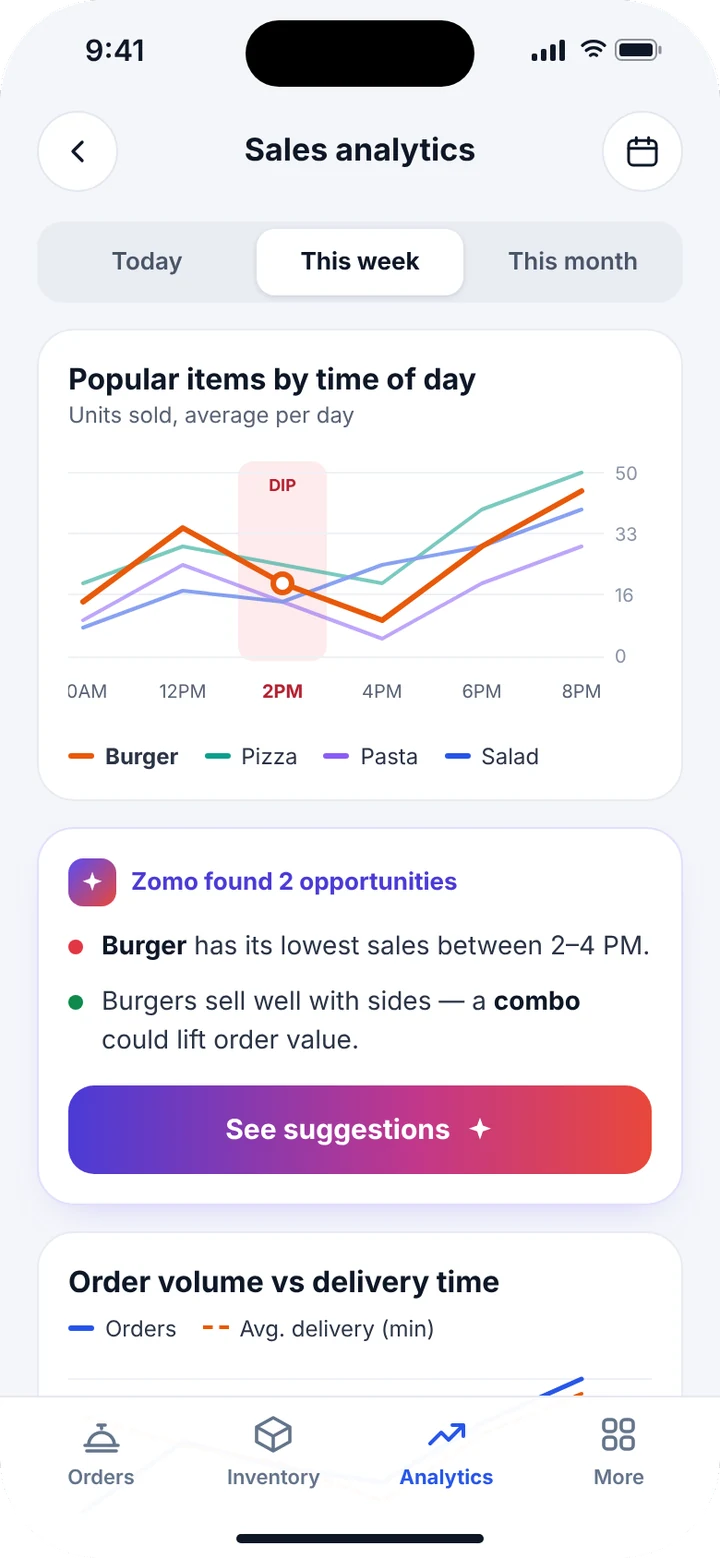
This view shows how each item performs through the day. The AI highlights patterns automatically, such as burger sales dropping sharply between 2 and 4 PM, so owners spot issues without manual analysis.
Analytics ✦“Burger sales are low between 2–4 PM. Offer a 10–20% discount during this window to boost performance.”
For a clear action plan to fix the dip, owners tap Get suggestions.
ReasoningOwners don't have time to interpret complex graphs during busy hours, so the AI surfaces only the most relevant patterns.
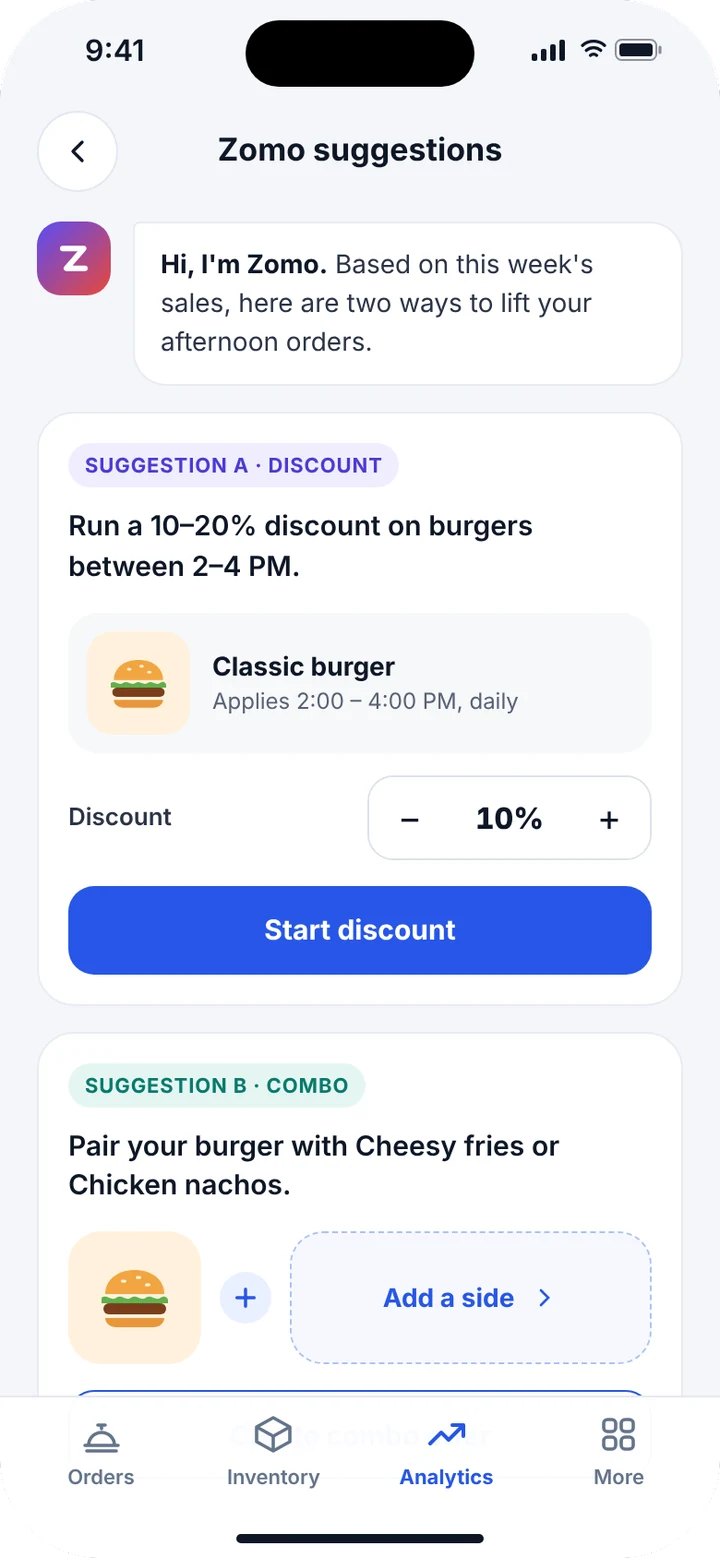
Tapping the button opens Zomo, the AI assistant, with contextual suggestions like applying a discount or launching an offer to revive slow items. A compact action panel lets owners respond instantly.
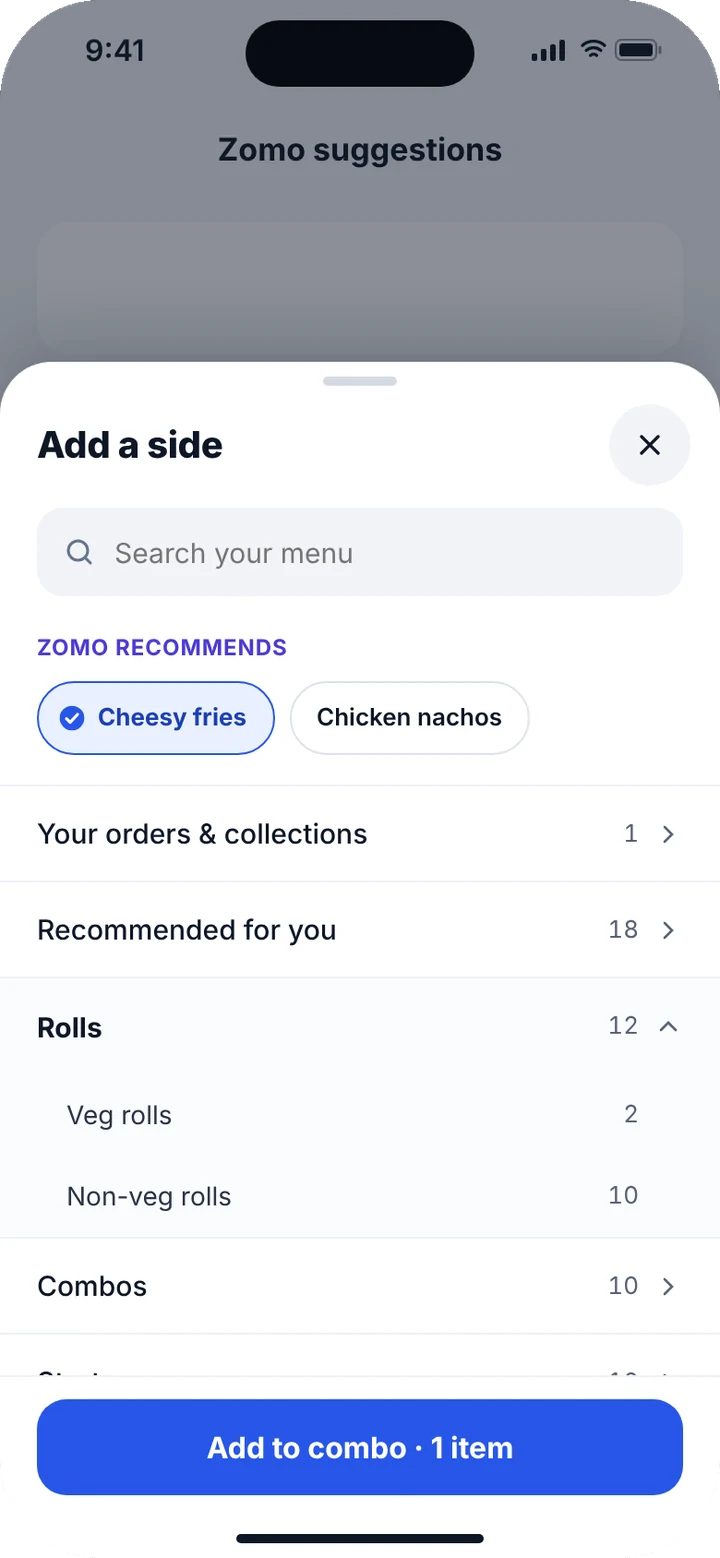
Suggestion B · Combo strategyWhen an item keeps underperforming, Zomo suggests another strategy, like bundling the burger with top sellers such as cheesy fries or chicken nachos.
Owners pick items for the combo from a menu sheet without leaving the flow.
ReasoningReduces the cognitive load on owners and makes them far more likely to act on insights promptly.
08 / Solution 03
AI-based ad creation. Local and platform data pre-fill every key field, so non-technical owners launch data-backed campaigns with minimal effort.
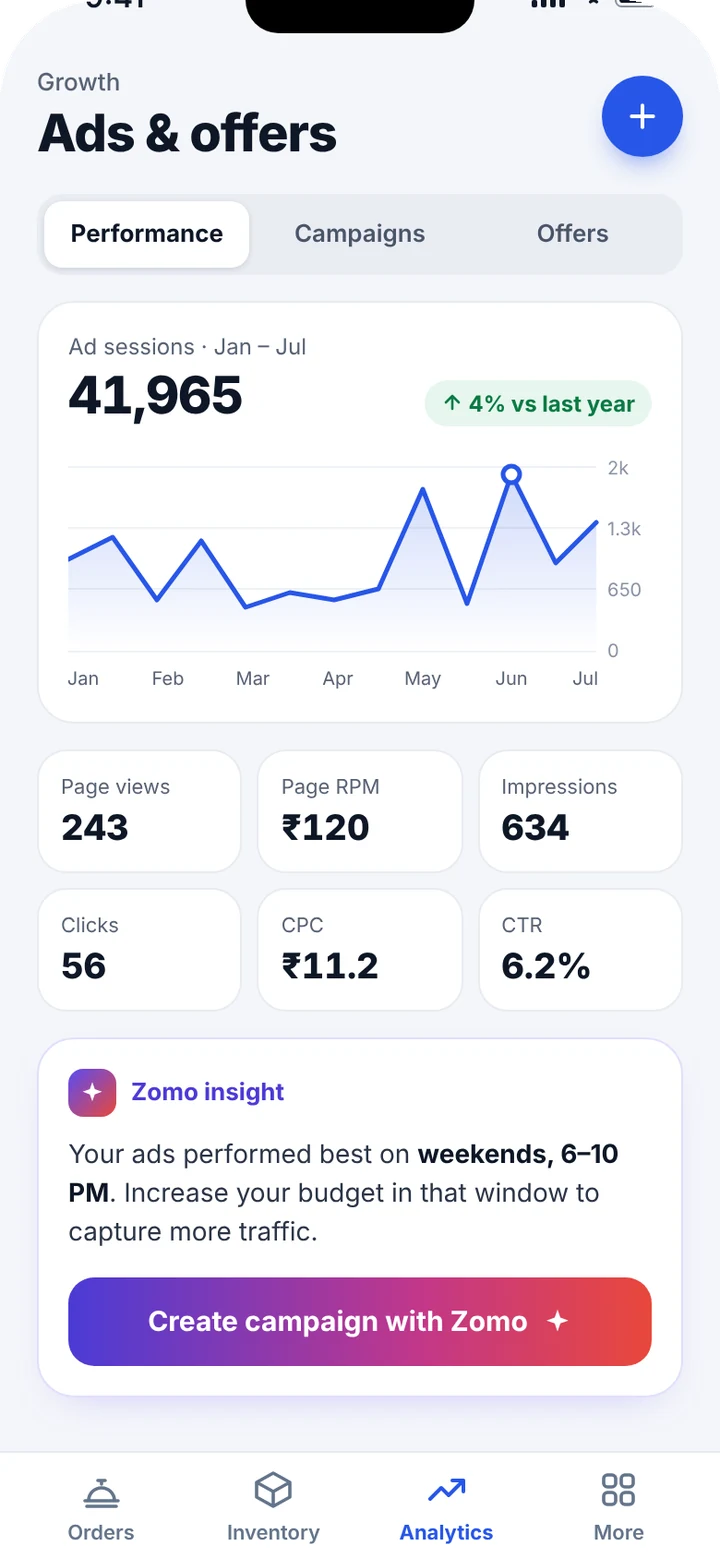
Your last campaign at a glance.
AI suggestions cardInstead of raw data, the system translates insights into a clear recommendation: “Your ads performed best on weekends between 6 and 10 PM. Consider increasing your budget during these hours.”
ReasoningHigh-level metrics come first to answer the core question, “Did my ad work?” Detailed numbers stay available without overwhelming anyone.
ImpactFaster understanding and less intimidation for non-technical users.
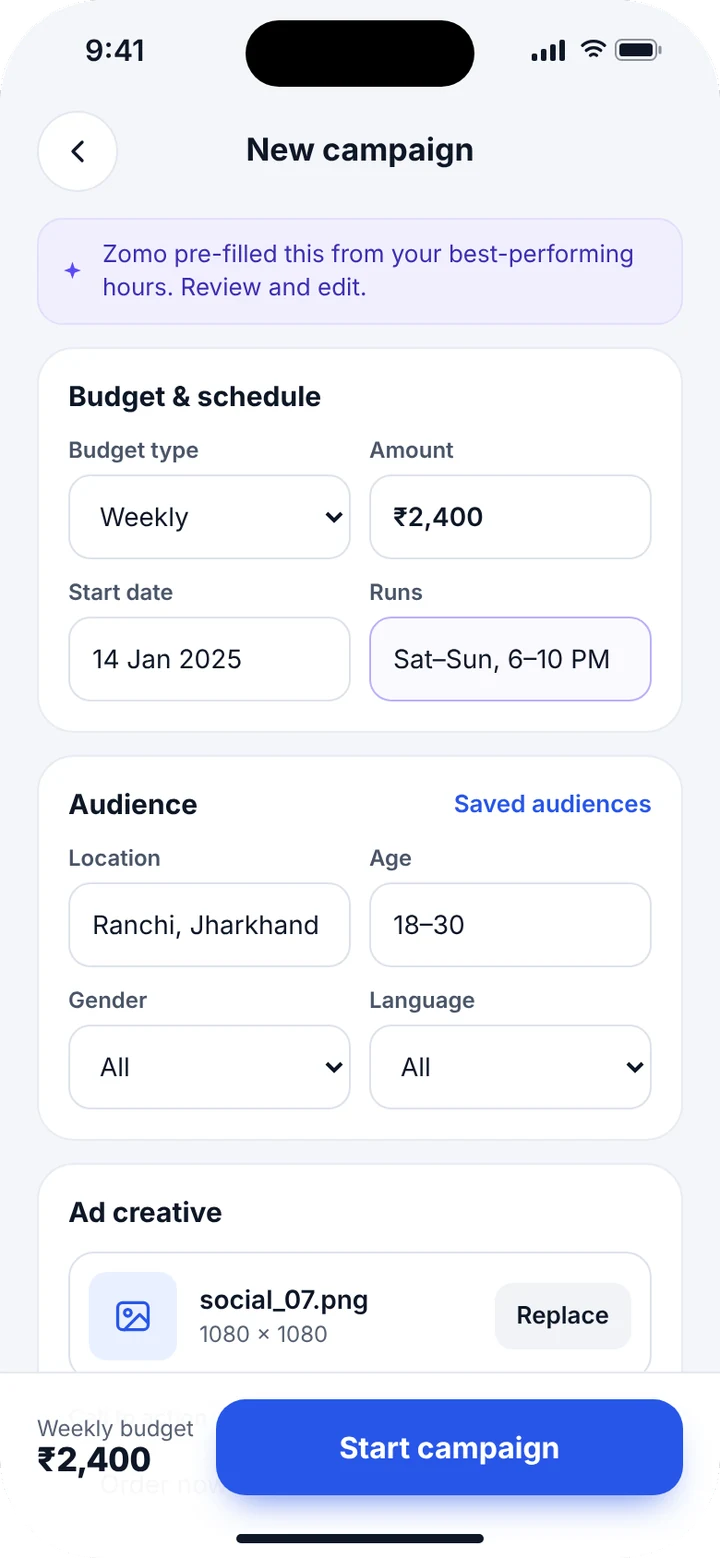
ReasoningDefault values act as recommendations, not restrictions, balancing automation with control. Reusing familiar assets reduces friction and speeds up decisions.
ImpactCuts setup time drastically while preserving trust. Owners think in outcomes, not targeting parameters, so they launch sooner and keep their branding consistent.

09 / Solution 04
A performance leaderboard. Progress becomes visible, and improvement earns real rewards.
Performance-based incentives like commission discounts and marketing credits, combined with AI suggestions, show owners exactly how to climb. Growth that's measurable and rewarding creates continuous motivation to improve service and stay competitive.
ReasoningAbstract metrics become meaningful when they're tied to a clear goal and visible momentum.
ImpactHigher analytics adoption, better decisions, and sustained motivation to optimise the business.
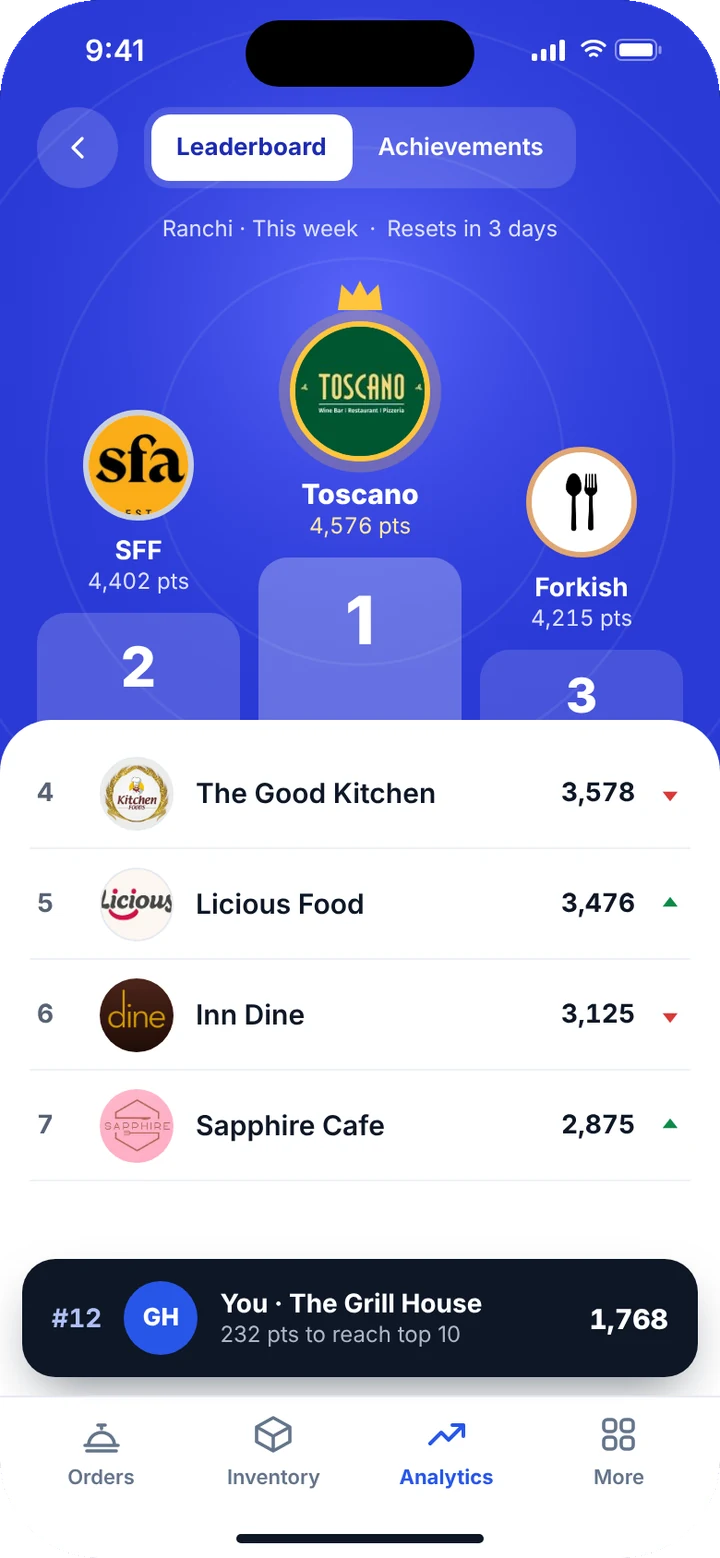
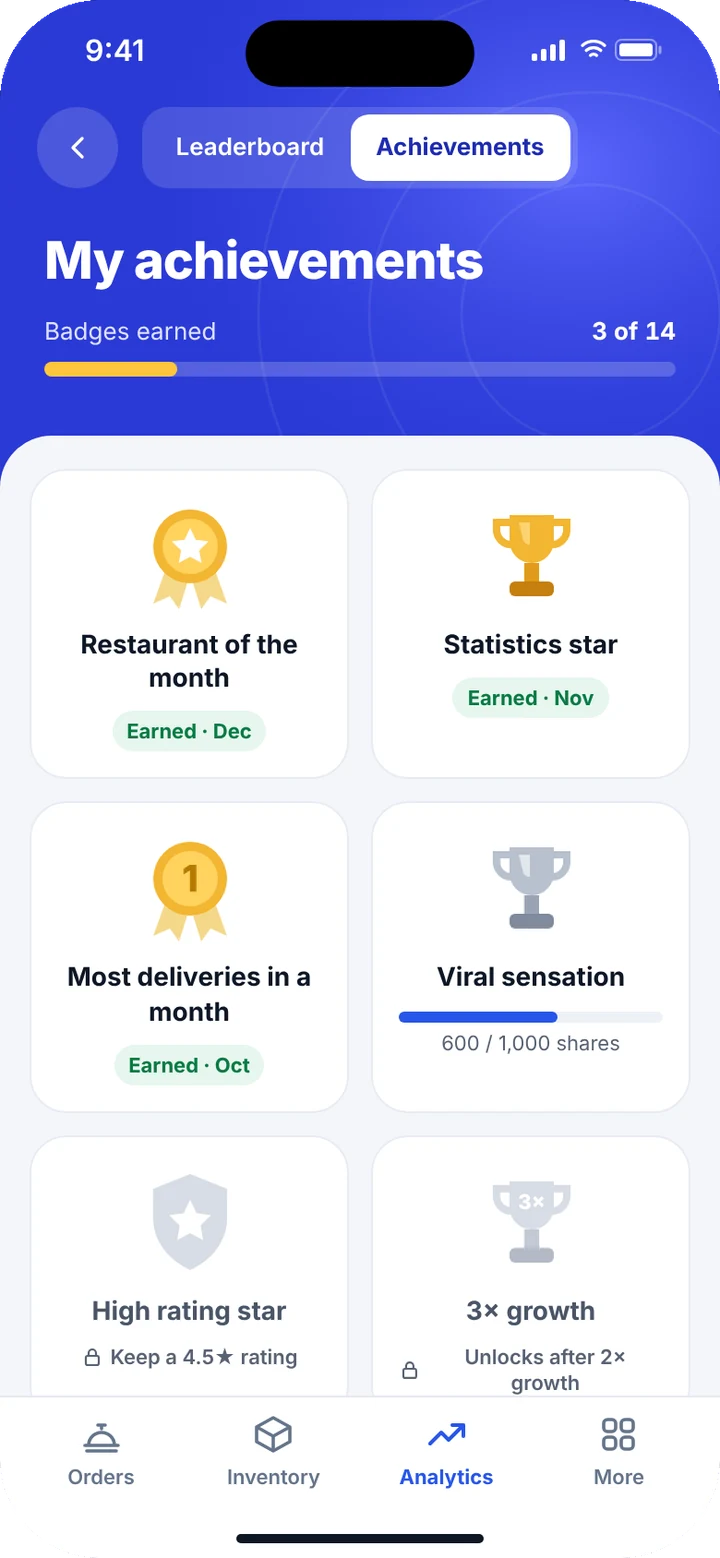
Achievements and rankings turn improvement into visible progress and recognition. Badges earned through analytics use and better metrics feed into rankings within the same restaurant category, creating healthy competition.
ReasoningBadges and rankings make progress visible and show what to improve next. Comparing within a category keeps competition motivating and achievable.
ImpactDrives analytics adoption, continuous improvement and repeat engagement by rewarding meaningful actions over time.
Other screens